https://www.aexcept.com/mastering-the-art-of-skateboarding-from-foundational-actions-to-advanced-street-safety/
Skateboarding practice involves a variety of movements, starting from basic movements and gradually progressing to more challenging ones, which is the key to improving skateboarding skills.
Basic Movement Practice
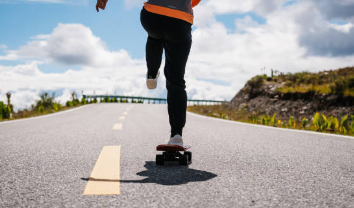
SlideSkating is the basic introductory action of skateboarding. When preparing to slide, the front foot should be placed steadily near the front axle nut of the skateboard, and the rear foot should press down firmly to push the skateboard forward. After the skateboard reaches a certain speed, quickly step on it with your hind foot. At this time, your body should maintain balance, and your knees should be slightly bent to cushion the vibration and maintain stability. You can choose a flat and open ground, such as a square or indoor smooth ground, and practice sliding repeatedly. At first, the sliding distance does not need to be too long each time, the focus is on experiencing the sliding characteristics of the skateboard and the balance control of the body on the skateboard. As proficiency improves, gradually increase the sliding distance and speed, and the practice duration can be controlled at 15-20 minutes per session, 2-3 times a day.
Turn
Turning is achieved by transferring the center of gravity of the body. Tilt your body’s center of gravity towards the turning direction, while applying appropriate pressure to the skateboard with your front foot to control its steering. Beginners first practice simple turns at low speeds, such as tilting their bodies slightly and feeling the changes in skateboard steering when sliding at a slower speed. Practice turning movements 10-15 times each time, gradually increasing speed and turning difficulty, and try different angles of turning. When practicing, it is important to pay attention to the smoothness of the body’s center of gravity transfer and avoid sudden exertion that may cause imbalance. Schedule 15-20 minutes per day specifically for practicing turning movements. As the practice progresses, it can be combined with sliding to naturally perform turning operations during the sliding process, enhancing the coherence of the movements.
Brake
There are various braking methods, commonly including foot brakes and using brakes to brake. When braking, gently rub the ground with your foot to slow down the skateboard until it stops. When operating, the heel of the foot should be slightly lifted, and the side of the foot should slowly touch the ground to gradually increase friction. At the same time, the body should maintain balance to avoid losing control of the skateboard due to foot brake action. If the brake is used, the brake position and tightness shall be adjusted in advance. The brake is usually installed at the rear of the skateboard. After adjusting to the appropriate position, when braking is needed, use the rear foot to step on the brake and use the friction between the brake and the ground to brake the skateboard. To master these two braking techniques proficiently, alternate between using the foot brake and the brake pedal during each practice, practicing 10-15 times each to ensure safe braking in different situations. Practice braking for 15-20 minutes every day to cope with various gliding scenarios.
Advanced Movement Practice
Ollie jumping
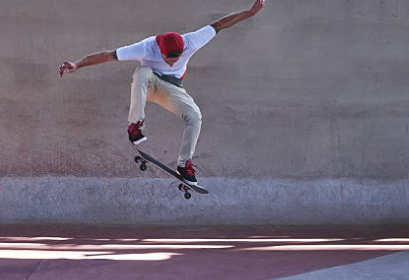
Dolphin jumping is a signature action of skateboarding advancement. Firstly, place the front foot near the board head and the rear foot at the edge of the board tail. When jumping, the hind foot quickly applies force to the tail of the board, while the front foot pulls upwards, using the force of the tail of the board to lift the skateboard off the ground as a whole. In the air, maintain balance with your body, slightly bend your legs, and control the height and direction of your skateboard. When landing, place your feet steadily on the skateboard and cushion the impact of the landing with your knees. Practicing dolphin jumping can start from the original position, practice 10-15 times each time, gradually increasing the jumping height. After mastering the stationary dolphin jump, practice the dolphin jump while sliding, and experience the skill changes of dolphin jump at different speeds based on the sliding speed. Schedule 20-30 minutes of practicing dolphin jumping every day, and as the practice time increases, try making some simple movements in the air, such as body twists, to increase the difficulty of the movements.
Kickflip
Sharp flipping is relatively complex and requires precise coordination of movements. Place the front foot slightly forward in the middle of the skateboard, and the rear foot on the tail side of the skateboard. First, perform the dolphin jumping action. At the moment when the skateboard is about to leave the ground, apply force to the tail side of the skateboard with the back foot, causing it to rotate horizontally. At the same time, the front foot moves in the direction of the skateboard’s rotation, maintaining control over the skateboard. In the air, keep your eyes on the skateboard and ensure that it rotates completely. When landing, place your feet accurately on the skateboard and control your balance. The difficulty of the tip flip exercise is relatively high. In the initial stage, it can be practiced by breaking down the movements. First, practice the power rotation movement of the back foot separately, 10-15 times each time. After becoming proficient, combine it with the dolphin jump for complete movement practice. Practice tip flips for 20-30 minutes every day, gradually increasing the speed of the movements as the skills improve, improving the fluency and success rate of the movements.
Heelflip
Translating is equally challenging. The front foot is located in the middle of the skateboard, and the back foot is on the other side of the tail of the skateboard. Similar to the tip flip, first perform the dolphin jump action. At the moment when the skateboard leaves the ground, apply force from the heel of the back foot towards the side of the back of the board, causing the skateboard to rotate horizontally in the opposite direction. Move the front foot in coordination with the rotation direction of the skateboard, and control the posture of the skateboard in the air. When landing, both feet accurately land on the skateboard, providing smooth cushioning. Practice somersault by slowly moving in place and carefully feeling the process of the back foot exerting force and the skateboard rotating. Practice 10-15 times each time. After becoming familiar with the stationary movements, practice sliding and flipping, and continuously adjust the rhythm of the movements based on the sliding speed. Spend 20-30 minutes practicing somersaults every day to gradually improve the quality and stability of the movements.
By practicing these basic and advanced skateboarding movements through the system, continuously improving skill proficiency, over time, significant progress can be made in the skateboarding field, unlocking more skateboarding fun.
https://www.aexcept.com/mastering-the-art-of-skateboarding-from-foundational-actions-to-advanced-street-safety/