
https://www.aexcept.com/the-ultimate-parkour-guide-from-beginner-basics-to-urban-flow/
Parkour, a passionate and challenging sport, attracts many people who aspire to break through themselves and showcase their physical potential with its unique charm. For beginners, how to safely and systematically embark on a parkour journey is the key to moving towards this cool sport. The following is a detailed introduction to the essential points for starting a parkour journey.
Master basic movement skills
Basic Action Learning
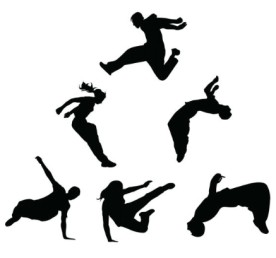
Basic parkour movements include landing, rolling, climbing, etc. When landing, the distance between the feet should be shoulder width apart, and the knees should be slightly bent to cushion and avoid the impact of straight leg landing on the knees. You can repeatedly practice jumping and landing on flat ground to familiarize yourself with the correct landing posture. Rolling can effectively disperse the impact force and protect the body. Start practicing by rolling in front of the ground with both hands on the ground, lowering your head and holding your chest, rolling your body in sync. After becoming proficient, practice rolling while moving, paying attention to controlling speed and direction. The key to climbing lies in the coordination of hands and feet, with fingers gripping the support points and feet firmly stepping on them, slowly climbing upwards. In the initial stage, low and stable climbing objects can be chosen for practice, gradually increasing the difficulty.
Action norms and practice frequency
Each action must strictly follow the norms to avoid developing habits of incorrect actions and increasing the risk of injury. When practicing, stay focused, feel the details of the movements, and focus on the quality of the movements rather than the quantity. Basic movement exercises should be performed daily, 10-15 times per exercise for each movement. As proficiency increases, the intensity and complexity of the exercises can be appropriately increased. At the same time, by watching professional parkour teaching videos, one can compare their own movements and correct errors in a timely manner.
Find a suitable training venue
Principles of venue selection
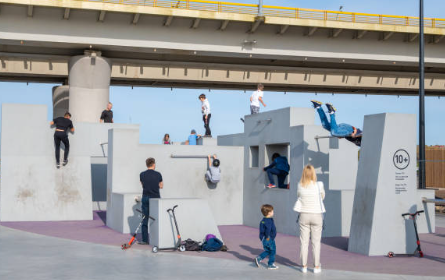
Safety is the primary principle when choosing a venue, avoiding training in areas with heavy traffic, dense crowds, or hazardous materials. Priority should be given to open, flat, and moderately cushioned areas such as parks, grasslands, and abandoned playgrounds. The park grass is soft, which can reduce the degree of injury when falling; The abandoned playground has a large space for practicing various movements. If indoors, you can choose spacious gyms, dance studios, etc. It is best to have rest areas around the venue for easy rest and hydration during training breaks.
Site exploration and adaptation
After selecting the venue, take time to familiarize yourself with the environment, observe the ground conditions, and check for any obstacles. Training on the grass, pay attention to whether there are potholes and sharp objects; On the abandoned playground, check if the ground is flat and if the facilities are stable. At the beginning of training, slow down and gradually adapt to the field. As you become familiar with the field and improve your own abilities, try more challenging movements and routes.
Take appropriate safety measures
Equipment preparation
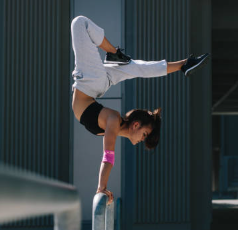
Appropriate equipment can reduce the risk of injury. A pair of lightweight, non slip, and well supported sports shoes is essential to provide protection for the feet and enhance stability during jumping and running. Choose loose and breathable materials for sportswear to facilitate physical activity and avoid wearing clothing that is too tight or restrictive. Knee and elbow guards can also be prepared to protect joints from injury during rolling and other movements.
Risk awareness cultivation
Parkour carries certain risks, and beginners should always maintain risk awareness. Warm up before training, move joints, stretch muscles, and reduce the risk of injury; During the training process, if you feel unwell or if you feel that your movements are dangerous, stop immediately. At the same time, it is important to understand common methods for handling sports injuries, such as emergency treatment for abrasions and sprains, in order to respond promptly in case of accidents.
Beginners embarking on a parkour journey need to be fully prepared from physical training, learning of movement techniques, site selection to safety protection. Through systematic training, gradually improve your abilities, enjoy the fun of parkour while ensuring your own safety, and embark on a dynamic and challenging adventure journey.
https://www.aexcept.com/the-ultimate-parkour-guide-from-beginner-basics-to-urban-flow/